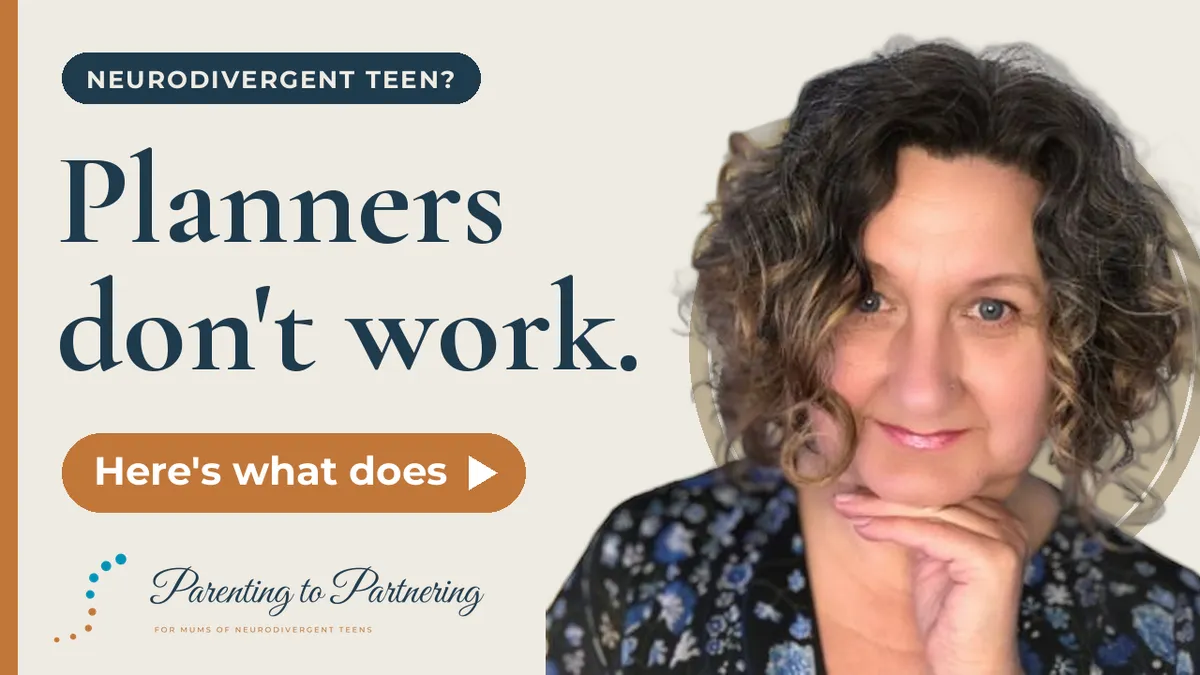
Why Planners Don't Work for Your Neurodivergent Teen (and What Does)
Why Planners Don't Work for Your Neurodivergent Teen (and What Does)
Have you ever bought your teen, your young adult, a planner? Helped them set it up? Looked at all the pretty colours and colour-coded everything, so they've got separate colours for when to get up, when to get the bus, when to do the washing. All of it.
You've probably taken days setting it up. Deciding on the colours. Maybe even using the stickers.
And what happens?
A week later, where is it? Not open, not used. And you're like, why don't they use it? We set it up. We said we were going to use it.
What you thought the planner would do
You bought it thinking it was going to make life a lot easier. You thought it would help them remember the important things, the things they needed to do. So they could have a system for organising themselves and wouldn't have to rely on what's in their brain. They could see it all.
But instead, you need to remind them to look in their planner. Then you need to remind them what to look for in their planner. So it's not quite doing the job you thought it was going to do.
And what if they just don't want to?
A planner is not the same as a working system
You can get very caught up in finding the tools. The planners, the apps. You might find one that's perfect for you, because that's how your brain works. But not perfect for somebody else.
And let's face it, we all love a good stationery shop, don't we? We'll get the planner, the stickers, the highlighters, the coloured pens. All of it. That seems great fun.
And then there's the next bit.
You might have a lovely planner. Maybe you've gone for the pastels, maybe the neons. It might be working for you. But it might not be working for them.
I must admit, I'm one of those people with planners. I can't find one that fits me, so I adapt mine. Yes, I like a colour, but I like it in steps. I like it in categories. So I cannot impose my planning onto somebody else. It's not how it works, is it?
Just because your system works for you doesn't mean it's going to work for somebody else.
What I see in the classroom
Remember, I'm a teacher as well, so I see this all the time with my students. We have so many different planners and so many different timetables, and they do not all work.
We can do nice visual timetables. They might look great. Put them through the laminator so they don't get spilt on. We can do all of that. But they get left, they get forgotten, they get put in a bag and pushed to the back.
It's not even about them not taking ownership. It's about it being right for them, so they can access it. And they're not all going to be the same. It needs to be a simple system, a really easy system they can relate to.
Some of this will be trial and error. Girls are stationery addicts, let's face it. Boys? If a pen works, that's normally fine. We have to take that into account.
Star charts at 15 and 16? Yes, really
My 15 and 16 year olds love a star chart. They love to see on the daily that they've got one, two, three stars. That's simple, that's straightforward, and they love to get stickers. The 13 and 14 year olds? "I'm too old for stickers." I know.
So we have to think about where they're at, because what works for one isn't necessarily going to work for another.
The magnetic star charts, where you can move things around, are quite visual. And they have to do something. They physically have to put that star on the chart. Bear that in mind. The sticker books with a picture for an appointment or a work day can work too. It needs to fit your individual.
This week's experiment
Bear in mind I'm a science teacher, so we're going to do lots of experiments. We have to, to find out what actually works.
Find one thing your teen or young adult struggles with regularly.Getting up? Washing their clothes? Just one thing. Don't overcomplicate it.
Don't download another app. Don't go out and buy another planner.
Ask them how they want to be reminded.Ask them what works for them. By the time they're 13, 14, 15, 16, they know what works. They know what doesn't work even more.
Work on that one thing and see what happens.
If you say "I'm going to buy you a nice planner with all these lovely colours, do you like them?" they'll probably say yes. The girls will go, oh, they look great. They'll make it look really nice. And then they might forget about it.
So have the conversation. Pick one thing. Little steps.
Next time we'll build on this and start building a system. Do your one experiment, get some results, and let me know how it goes.
I'm Tracey Montgomery and I help mums of neurodivergent teens get ready for independent living. Find out more at traceymontgomery.org.